Reinforcement learning (RL) and model predictive control (MPC) are powerful techniques for optimizing control systems. Both methods have their strengths and weaknesses, and the best approach for a particular problem will depend on the specific requirements of that problem.
If you want to know more about Model-based MPC and Machine Learning based MPC check out my previous blog.
Previous Post
A Comparison of Model-Based MPC and Machine Learning MPC
Model Predictive Control (MPC) is a widely used control strategy that has been employed in many fields, including…
In this blog post, we will compare MPC with RL.
Reinforcement learning
Reinforcement learning is a type of machine learning that learns by trial and error. It is particularly well-suited for problems with complex dynamics or unknown system models. In RL, the agent learns to act in an environment to maximize a reward signal. The agent interacts with the environment, observes the resulting state, and takes action. The agent is then given a reward or penalty based on the outcome. Over time, the agent learns to take actions that lead to more positive rewards. RL has several applications in control systems, offering a dynamic and adaptive approach to optimize system behavior. Some common applications:
- Autonomous Systems: RL is used in autonomous control systems, such as self-driving cars, drones, and robots, to learn optimal control policies for navigation and decision-making.
- Robotics: RL enables robots to learn and adapt their control strategies for tasks like grasping objects, manipulation, and locomotion in complex and dynamic environments.
- Industrial Processes: RL can be applied to optimize the control of industrial processes, such as chemical plants and manufacturing systems, by learning optimal control policies to maximize efficiency and minimize energy consumption.
- Energy Management: RL is used in smart grids and energy systems to optimize energy consumption, demand response, and grid management, considering variable energy sources and dynac demand patterns.
- Traffic Control: RL can be applied to optimize traffic signal control in transportation systems, improving traffic flow, reducing congestion, and minimizing travel times.
- Adaptive Control: RL can adaptively adjust control parameters based on real-time feedback, allowing systems to adapt to changes in the environment or uncertainties.
- Game Theory in Control Systems: RL techniques, particularly multi-agent RL, can be employed to model and optimize interactions between multiple entities in a control system, ensuring cooperation or competition among agents.
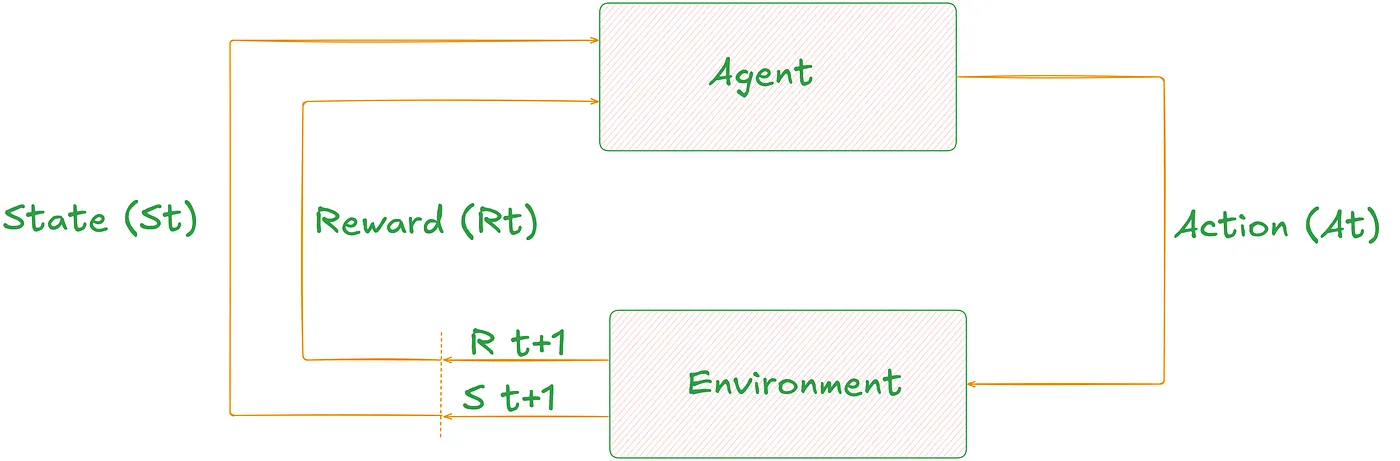
Key points In RL:
- Agent: Learner and decision maker.
- Environment: Surroundings or entities the agent interacts with. The Agent observes and takes action, influencing the environment.
- State: A complete description of the world's state. A state can be fully observed or partially observed by the agent.
- Reward: Scalar feedback indicating the agent's performance. Agent aims to maximize total long-term rewards. Basis for altering the policy.
- Action Spaces: Set of valid actions an agent can perform in a given environment. Finite actions constitute discrete action spaces; infinite actions constitute continuous action spaces.
Model predictive control
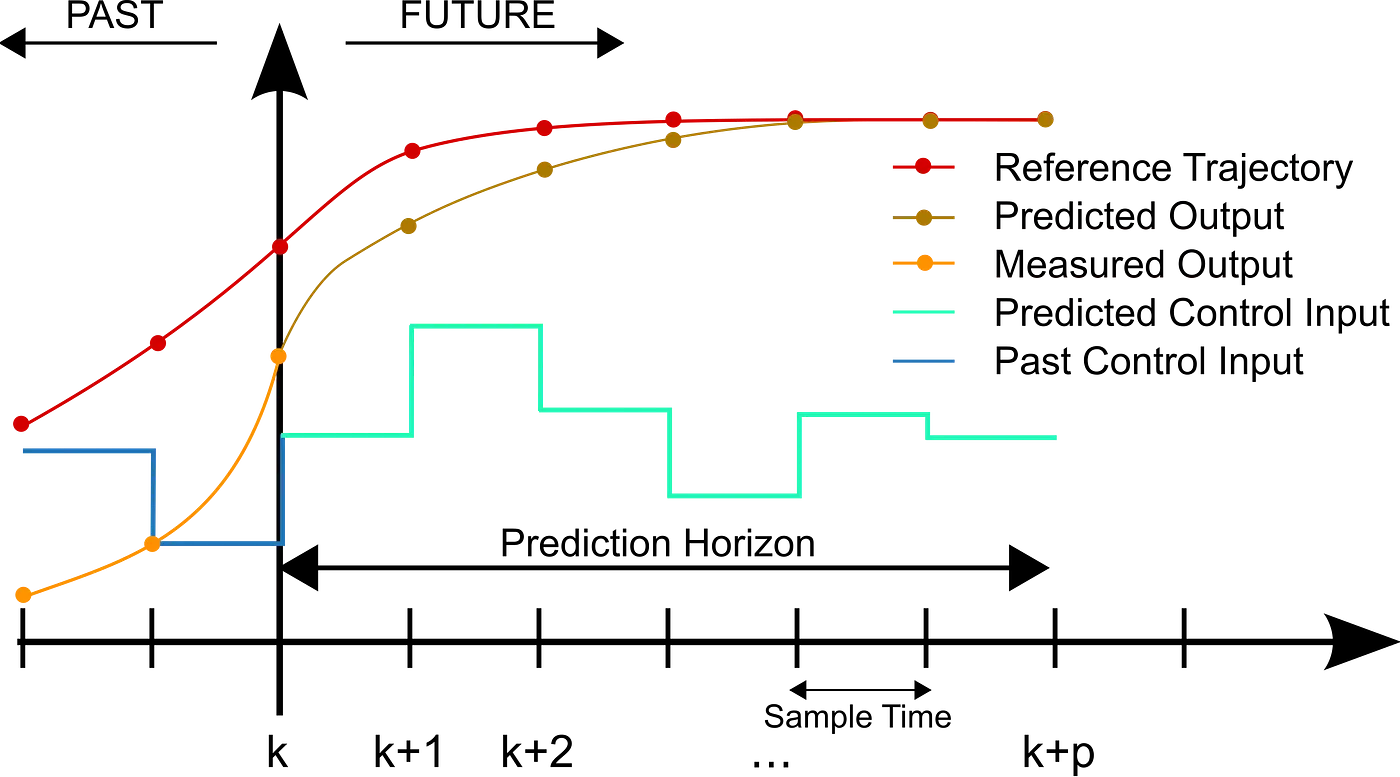
Model Predictive Control (MPC), also referred to as moving horizon control or receding horizon control, is a widely used control strategy that has been employed in many fields, including process control, robotics, and autonomous systems. MPC's central tenet is to Predict future behavior using a mathematical model of the system, and then utilize that knowledge to produce control actions that maximize some performance objective. MPC can now handle increasingly complicated systems and difficult control issues because of years of continual improvement and refinement. As shown in the Figure below, at each control interval the MPC algorithm computes an open-loop sequence of control horizon to optimize plant behavior in the prediction horizon.
Here are some applications of MPC in control systems:
- Process Industries: MPC is widely used in chemical, petrochemical, and other process industries to optimize the control of complex processes. It ensures the optimal utilization of resources, maximizes production efficiency, and minimizes deviations from desired setpoints.
- Power Systems: MPC is applied in power systems to optimize the scheduling and dispatch of power generation units, considering factors like load demand, fuel costs, and system constraints. It helps in achieving efficient energy production and grid stability.
- Automotive Control: MPC is employed in vehicle control systems, such as engine control and hybrid vehicle management, to optimize fuel efficiency, reduce emissions, and enhance overall vehicle performance.
- Robotics: MPC is used in robotic systems to plan and optimize motion trajectories, ensuring smooth and efficient movement of robotic arms and platforms in various applications, including manufacturing and logistics.
- Building HVAC Systems: In heating, ventilation, and air conditioning (HVAC) systems, MPC is utilized to optimize temperature control, energy consumption, and comfort levels in buildings, adapting to changg external conditions.
- Bioprocess Control: MPC is applied in bioprocessing industries to control the production of pharmaceuticals, biofuels, and other biological products by optimizing the operation of bioreactors and ensuring product quality.
- Aerospace Systems: In aerospace applications, MPC is used for aircraft control, trajectory planning, and guidance systems, optimizing flight paths and ensuring stability in the presence of uncertainties.
- Renewable Energy Integration: MPC is employed in the integration of renewable energy sources, such as wind and solar, into the power grid. It helps in managing the intermittent nature of these sources and maintaining grid stability.
- Traffic Control: MPC is used in traffic signal control systems to optimize signal timings and manage traffic flow in real-time, reducing congestion and improving overall transportation efficiency.
- Water Treatment Plants: MPC is applied in water treatment processes to optimize the dosing of chemicals, control water quality, and ensure the efficient operation of treatment plants.
Comparison of RL and MPC
Here is a table summarizing the strengths and weaknesses of RL and MPC:
| Feature | Reinforcement Learning | Model Predictive Control |
|---|---|---|
| Model | It can be with or without a model of the system | requires a model of the system |
| Learning | Learns through trial and error | Uses a mathematical model to predict the future |
| Speed | Can be slow to learn, especially for complex problems | Can be faster to learn, especially for simpler problems |
| Robustness | Can be sensitive to changes in the system | More robust to changes in the system |
| Sample efficiency | Can be very sample-inefficient | More sample efficient than RL |
| Applicability | Can be applied to a wide range of problems, including problems with complex dynamics or unknown system models | Typically used for problems with known or well-modeled dynamics |
| Strengths | Weaknesses | |
|---|---|---|
| Reinforcement Learning | Can learn to control systems with complex dynamics or unknown system models | Can be slow to learn, especially for complex problems |
| Model Predictive Control | More sample efficient than RL | Requires a model of the system |
In general, RL is a good choice for problems that are difficult to model or have complex dynamics. MPC is a good choice for problems that are well-modeled and have predictable dynamics. In future blog posts, will provide an implementation of RL with OpenAI Gym in Python.